
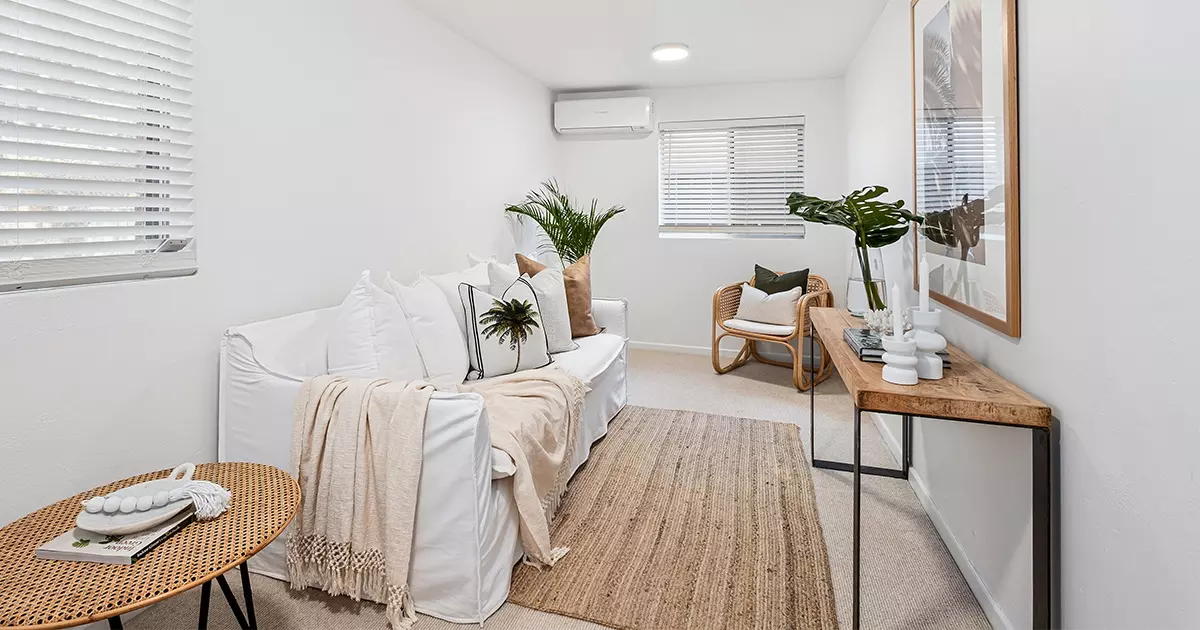
In contemporary interior design, understanding what colors make a room look bigger has become essential, as optimizing spatial perception is increasingly important across urban housing projects, studios, and hospitality environments where maximizing visual space is a priority.
This article explains colors that make a room look bigger, how they influence spatial perception, and why certain strategies are more effective than others in transforming small interiors into visually more spacious environments.
What colors make a room look bigger and brighter?
In contemporary urban living, where apartments are becoming increasingly compact, optimizing perceived space has become a key priority in interior design. Within this context, understanding what colors make a room look bigger and brighter is essential for creating functional and visually balanced environments.
When analyzing this, designers consistently rely on light-reflective and low-contrast palettes, such us:
- Soft whites and off-whites
- Light beige and greige tones
- Pale grey and muted neutrals
- Soft pastel shades
The colors that make a room look bigger are closely aligned with the Pantone Color of the Year 2026, an off-white tone that enhances natural light distribution and reduces visual fragmentation in small interiors.
Read more: “Small apartment design ideas for modern urban homes”
Paint colors for small rooms
Selecting the best paint colors for small rooms depends on lighting conditions, room function, and material coordination.
Paint colors to make a room look bigger:
- Warm white for living areas
- Soft grey for modern bedrooms
- Neutral beige for multifunctional spaces
- Pale blue for calm, reflective environments
These light paint colors for small rooms work particularly well when combined with reflective surfaces and minimalist furniture layouts.
Read more: “Minimalist interior design: Ideas for modern spaces“
In many projects, colors are coordinated with textiles and wallpapers to ensure visual harmony, as seen in Aldeco’s collections.

How to paint a room to make it look bigger
Understanding how to paint a room to make it look bigger goes beyond color selection. Application technique plays a critical role in spatial perception.
Effective methods include:
- Extending wall color onto the ceiling to remove visual boundaries
- Using monochromatic palettes to reduce contrast
- Avoiding heavy visual breaks between walls, trims, and ceilings
- Applying matte or satin finishes to soften reflections
These techniques are central to how to paint a small room to look bigger, especially when working with limited space and lighting constraints.
Color ideas for small rooms and spatial applications
Color ideas for small rooms are often influenced by overall interior design style, especially in compact spaces where light and simplicity play a key role. In this context, colors for small spaces are typically shaped by the need to maximize visual continuity and reduce contrast.
Minimalist, Scandinavian, and contemporary neutral styles work particularly well in small interiors, as they prioritize visual simplicity, light continuity, and low contrast. Combined with carefully selected colors for small rooms, these approaches help create spaces that feel more open and cohesive.
In the end, it is the combination of style and palette that shapes the perception of space.


